

Microstrain Little Sensors. Big Ideas.

displacement banner

DEMOD- DVRT® -TC

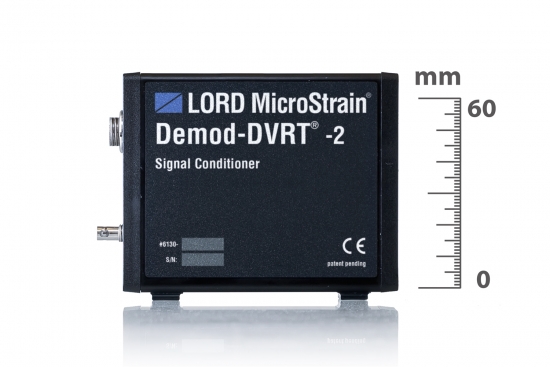
Demod-DVRT-TC Signal Conditioner

Carrier Amplifier-Oscillator/Demodulator for DVRTs®; Inductive, Capacitive and Resistive Bridge Circuits.

Designed for ease of use and general versatility, this printed circuit card provides complete temperature compensated conditioning for any sensors. The DEMOD-DVRT® -TC utilizes both alternating current and direct current excitation of the sensor’s inductive bridge to accurately measure position in the face of temperature gradients. Each card contains the requisite components to facilitate plug-and-play use, including active, jumper selectable low pass filters, input supply line filters with reverse input protection, and output line buffers. The DEMOD-DVRT® -TC sine wave excitation and synchronous demodulator provide excellent noise rejection and elimination of thermally induced potentials.

Demod-DVRT-TC Signal Conditioner

High Performance

  • temperature compensated signal conditioning
  • precision synchronous demodulation
  • rapid warm-up time

Ease of Use

  • plug-and-play with LORD MicroStrain® motherboards
  • compatible with all LORD MicroStrain® DVRT sensors
  • adjustable trimmers to set resolution range

Compensates for a temperature gradient across the sensor

Sensor types

inductive (DVRT®)

Excitation

regulated sinewave, 70 KHz typical

Demodulation

synchronous, DC output

Output

± 4.5 volts typical

Gain

factory adjustable 10-10,000

Low pass filter

2 pole, active Butterworth, 3 dB down @ 1 KHz standard; factory adjustable 10 Hz-8 Khz

Supply voltage

motherboard supplies power (typical), ± 6.5 volts min, ± 16 volts max (when used without motherboard)

Supply current

30 milliamps per rail

Warm-up time

15 minutes recommended

Operating temperature

-40 to 85˚C

PC board size

12mm x 48mm x 20mm (thick)

Connectors

10 pin, .1" pitch header (power, ground); LEMO 4 pin receptacle (bridge points); BNC (analog output)

Trimmers

offset (std.)


#1342: How do I repair or return a LORD MicroStrain® product?

In order to return any LORD MicroStrain® product either for repair or return, you must contact us for a Return Merchandise Authorization number (RMA). If you purchased directly from LORD MicroStrain® in the United States, please contact your Sales or Support Engineer to obtain an RMA.  If you purchased directly from a LORD MicroStrain® distributor, please contact your distributor to obtain an RMA.

Direct link: view

#1340: Where do I purchase LORD MicroStrain® products?

If you are located in the United States, LORD MicroStrain® supplies you directly.  If you are in located in another country, LORD MicroStrain® products are available exclusively from LORD MicroStrain® distributors.  Please use this locator to determine your distributor: http://www.microstrain.com/support/international

Direct link: view

#1339: Does LORD MicroStrain® provide a trial period for its products?

To enable customers to try our standard products risk free, LORD MicroStrain® offers a 30 day return on the purchase of a starter kit. In order to take advantage of this offer, a purchase order or payment for the starter kit is required when the order is placed. 30 day trial details may be found at: http://www.microstrain.com/support/warranty

Direct link: view

#1338: How do I get support for my LORD MicroStrain® products?

LORD MicroStrain® Support Engineers are always available to support you in any way we can by phone, email, SKYPE or Live Chat from our home page.  Contact details may be found at: http://www.microstrain.com/support/contact-support

Direct link: view

#1337: What is the shipping policy for LORD MicroStrain® products?

LORD MicroStrain® insures all products shipments to their full value unless the customer specifically states a different method.

Direct link: view

#1336: What is the warranty for LORD MicroStrain® products?

LORD MicroStrain® warrants its standard products to be free from defective material and workmanship for a period of one (1) year from the original date of purchase.  Warranty details may be found at: http://www.microstrain.com/support/warranty

Direct link: view

#1065: What is the maximum cable length between a DVRT and its DEMOD signal conditioner?

If you are using the standard cable type supplied with the DVRT sensors, 20 feet is the maximum for M-DVRT and MG-DVRT, and 60 feet is the maximum for S-DVRT, SG-DVRT and NC-DVRT. If you require longer cable lengths, LORD MicroStrain® can provide custom cables of lower resistance.

Direct link: view

#1064: Does carbon fiber affect the analog output from the DVRT?

No, carbon fiber has not been shown to pose a problem.

Direct link: view

#1062: How do I use the calibration documents provided with each DVRT?

In most cases, MicroStrain calibrates every DVRT with its accompanying electronics and provides a detailed calibration certificate. The certificate provides 3 methods of calibration and all the particulars including formulas to resolve voltage into engineering units.

  • Standard Least Squares Linear Fit provides a simple mathematical method to convert sensor output to displacement and delivers reasonable accuracy.
  • Polynomial Fit provides a more mathematically intensive method to convert sensor output to displacement and in turn delivers a high degree of accuracy. A possible drawback to some users of this method may be that it can not accurately report measurements beyond its stroke length (i.e., over-stroking).
  • Multi-Segment Linear Fit provides the most mathematically intensive method to convert sensor output to displacement, delivers a high degree of accuracy and is not subject to the drawback of over-stroking.
Direct link: view

#1060: What's the output from the DVRT?

The output is an analog DC voltage proportional to linear displacement.  The full scale voltage is optionally +/-5 volts or 0-10 volts.  The analog voltage is easily read using a multi-meter or DAQ.  The voltage can also be read in the digital domain by using LORD MicroStrain® Smart Motherboards.  These Smart Motherboards provide a data gateway to PC-based software or to user-programmable LCD displays on the motherboard itself.

Direct link: view

#1054: Are DVRTs calibrated?

Typically, every DVRT is calibrated at the factory with its accompanying DEMOD signal conditioner.  The calibration is made over the entire system (DVRT and DEMOD) to insure the highest accuracy.  DVRTs and DEMODS are color-coded to insure that they stay together as a pair when in use.

Direct link: view

#1053: Where would I find scientific papers describing the use of DVRTs?

LORD MicroStrain® posts links to a number of published scientific papers at: http://www.microstrain.com/company/scientific-papers

Direct link: view

#1052: Which of the DEMOD signal conditioners provide temperature compensated conditioning?

DEMOD Type Temperature Compensation
DEMOD-DVRT No
DEMOD-DVRT-TC Yes
DEMOD-DC No


Direct link: view
Related products:

#1051: Do DVRTs always require a Motherboard or Smart Motherboard to operate?

No.  LORD MicroStrain® makes a DEMOD-DC which provides an alternate method of DVRT signal conditioning.  The DEMOD-DC provides conditioning as an in-line connector and connects to your DAQ.  Although not normally recommended, a DEMOD-DVRT or a DEMOD-DVRT-TC can be used without its Motherboard enclosure; external power is the only requirement.

Direct link: view

#1049: What is a ‘Motherboard’ and what is the difference between a standard Motherboard and a Smart Motherboard?

The term ‘Motherboard’ refers to the LORD MicroStrain® DEMOD-DVRT or DEMOD-DVRT-TC signal conditioner mounting chassis.  The standard Motherboard provides a mounting slot and power to the individual DEMODs.  The Smart Motherboard provides a mounting slot, power and digital communications (RS-232) to the individual DEMODs.  Both Motherboard and Smart Motherboard provide analog ouput to a DAQ.  In addition, Smart Motherboard provides digital output to a computer.  Motherboards and Smart motherboards can accommodate 1 to 8 DEMOD cards.

Direct link: view

#1047: Can an LVDT use the DEMOD signal conditioning electronics?

In a word, no. The design of an LVDT’s coil forms a Wheatstone full bridge and the design of LORD's DVRT coil forms a Wheatstone half-bridge. LORD MicroStrain® signal conditioning electronics are designed for the half-bridge.  Likewise, a DVRT can not use a LVDT's signal conditioning electronics.

Direct link: view

Buy

How To Order

To discuss configuration for your specific system requirements, please contact sales at sales@microstrain.com or call  802-862-6629.

For large quantity orders or OEM discussions, please contact mirobinson@microstrain.com.

If you are outside the US, please contact one of our distributors.

Applications

Used with LORD MicroStrain® DVRT® sensors for:

  • Invivo Strain, Micromotion and deformation in Bone & Tissue
  • Process Control for Production-Line Monitoring
  • Miniature Position Control Elements
  • Linear & Angular Motion Control
  • Measuring Strain and Deflection in Materials and Structures
  • Dimensional Gauging for Quality Control

Related Products

  • DEMOD-DCDEMOD-DC® - Carrier Amplifier-Oscillator/Demodulator for DVRTs®; Inductive, Capacitive and Resistive Bridge Circuits.
  • DEMOD-DVRTDEMOD-DVRT® - Carrier Amplifier-Oscillator/Demodulator for DVRTs® Inductive, Capacitive and Resistive Bridge Circuits.
  • DVRT-LinkDVRT-Link™ -LXRS® - Wireless Displacement Sensor Node