

NEW VERSION
There is a new version of this product available. The product on this page has been discontinued and the datasheet and manual are provided for informational purposes.
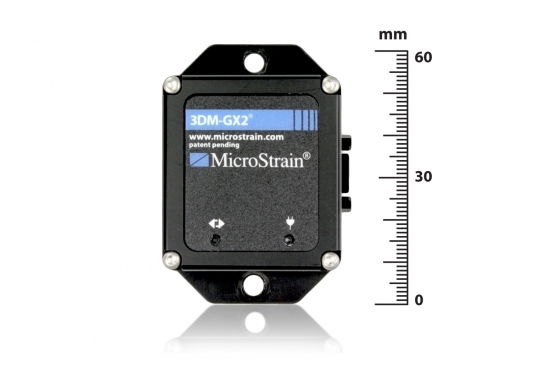
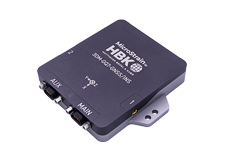
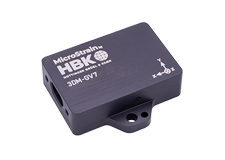
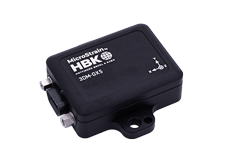
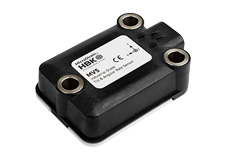
3DM-GX2® is a high-performance gyro enhanced orientation sensor which utilizes miniature MEMS sensor technology. It combines a triaxial accelerometer, triaxial gyro, triaxial magnetometer, temperature sensors, and an on-board processor running a sophisticated sensor fusion algorithm.
3DM-GX2® offers a range of output data quantities from fully calibrated inertial measurements (acceleration, angular rate and magnetic field or deltaAngle & deltaVelocity vectors) to computed orientation estimates (pitch & roll or rotation matrix). All quantities are fully temperature compensated and corrected for sensor misalignment. The angular rate quantities are further corrected for G-sensitivity and scale factor non-linearity to third order.
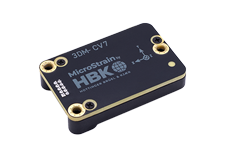
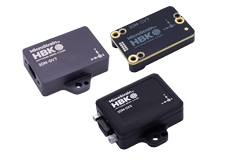
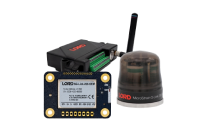
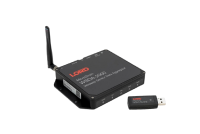
3DM-GX2®'s communications interface hardware is contained in a separable module, and can therefore be easily customized. Currently available interface modules include a wireless transceiver, USB 2.0, RS232 and RS422. An OEM version is available without the communications interface enabling the sensor to be integrated directly into a host system's circuitboard, providing a very compact sensing solution.
The system architecture has been carefully designed to substantially eliminate common sources of error such as hysteresis induced by temperature changes and sensitivity to supply voltage variations. The use of six independent Delta-Sigma A/D converters (one for each sensor) ensures that all sensors are sampled simultaneously, and that the best possible time integration results are achieved. On-board coning and sculling compensation allows for use of lower data output rates while maintaining performance of a fast internal sampling rate. 3DM-GX2® incorporates an integral triaxial magnetometer; optionally, the magnetometer can be located remotely to reduce hard and soft iron interference.
The 3DM-GX2® Software Development Kit (SDK) provides application builders with robust protocols and source code samples to operate the Inertia-Link® and 3DM-GX2® orientation sensors. The SDK includes a complete Data Communications Protocol manual, a detailed Users manual, ANSI C Implementation and API. Sample applications demonstrating many protocol commands are provided with fully-commented source code for Microsoft® Visual Studio C++ 2003/2008 Express, LabVIEW® 7.1.1, Microsoft® Visual Studio Visual Basic 2005 and Microsoft® Visual Basic 6.0.
Product no longer stocked – limited availability
Contact for pricing and lead time--a minimum order quantity may apply
Datasheet Manual
| Orientation Range (pitch, roll, yaw) |
360° about all axes |
| Accelerometer range | +/- 5 g standard +/- 1.7 g and +/- 18 g also available (+/- 18 g may require export license) |
| Accelerometer bias stability | ± 0.010 g for ± 18 g range ± 0.005 g for ± 5 g range ± 0.003 g for ± 1.7 g range |
| Accelerometer Nonlinearity | 0.2% |
| Gyro range | Gyros: ± 300°/sec standard, ± 1200°/sec, ± 600°/ sec, ± 50°/sec also available |
| Gyro Bias Stability | ± 0.2°/sec for ± 300°/sec |
| Gyro nonlinearity | 0.2% |
| Magnetometer range | ± 1.2 Gauss |
| Magnetometer nonlinearity | 0.4% |
| Magnetometer bias stability | 0.01 Gauss |
| A/D resolution | 16 bits |
| Orientation Accuracy | ± 0.5° typical for static test conditions ± 2.0° typical for dynamic (cyclic) test conditions & for arbitrary orientation angles |
| Orientation resolution | <0.1° minimum |
| Repeatability | 0.20° |
| Output modes | Acceleration and angular rate, deltaAngle and deltaVelocity, Euler angles, rotation matrix |
| Interface options | RS232, RS422, USB 2.0 and wireless - 2.45 GHz IEEE 802.15.4 direct sequence spread spectrum, license free worldwide (2.450 to 2.490 GHz) - 16 channels |
| Wireless communication range | 70 m |
| Digital output rates | Standard RS-232, USB or RS-422 interface: Up to 237Hz Wireless interface: Up to 100Hz OEM or custom interface: Up to 1000Hz |
| Serial data rate | 115200 bps |
| Supply voltage | +4.5 to 16 volts |
| Power consumption | 90 mA |
| Connectors | micro DB9 |
| Operating temp. | -40 to +70°C with enclosure -40 to +85°C without enclosure |
| Dimensions | 41 mm x 63 mm x 32 mm with enclosure 32 mm x 36 mm x 24 mm without enclosure |
| Weight | 50 grams with enclosure, 21 grams without enclosure |
| Shock limit | 1000 g (unpowered), 500g (powered) |
| RF Output Power | 0dBm (1 mW) |
U.S. Patents Pending
No, not currently. If you need an analog out option, please consider our 3DM-GX1® at:
Yes. We provide a complete data communications protocol manual which describes in detail each and every command and response that is available with the devices. Applications may be developed in any programming environment (C, VB, LabVIEW, Matlab, etc.) which supports communication via serial port.
© HBK, Inc 2023
Privacy Statement |
SensorCloud™ Services Agreement |
Terms & Conditions of Sale